Should You Buy Leads or Build Your Own Audience?
Facts checked against sources
Short answer
Buying leads is worth it when your cost per customer from a vendor sits well below what a customer is worth and you need volume this quarter. It stops being worth it as the main plan, because nothing remains when you stop paying. Most businesses should keep buying what they need now while building their own audience, which keeps working and compounds.
Every business that sells to the public gets customers in one of three ways. Most only think about two of them, and they usually spend the most on the one that leaves them with the least.
This guide is the map. It starts with the question most lead buyers actually ask, whether buying is worth it at all, then explains what each approach buys you and how to move money between them without wrecking a quarter.
Is buying leads worth it?
Buying leads is worth it sometimes, and you can find out with your own numbers. Buying is worth it when a vendor's leads turn into customers at a total cost well below what those customers earn you. It is not worth it when you only look at the price per lead.
The honest answer depends on a few conditions. Check yours against the table before deciding to buy more, cut back or stop.
| Your situation | Buying leads is probably | Why |
|---|---|---|
| Cost per customer from the vendor is well under customer profit | Worth it, for now | Each purchase returns more than it costs, even after sales time and returns |
| You need volume this quarter and have no other source | Worth it as a bridge | Owned channels take months to produce, and payroll doesn't wait |
| Shared leads, slow follow-up, low contact rates | Not worth it yet | You are paying to lose races to faster buyers; fix the process first |
| Vendor can't show traffic sources or consent proof | Not worth the risk | Cheap leads with weak consent can cost more in legal exposure than they earn |
| Lead spend is most of your marketing, year after year | Worth it per lead, costly as a strategy | Every year starts from zero and the vendor keeps the audience |
To run the first row properly, work out cost per lead vs cost per acquisition for each vendor. To check the fourth, use the questions in how to evaluate a lead vendor.
So the real question isn't buy or don't buy. It's whether buying should stay your main plan, or whether it should fund the time it takes to generate your own.
Should you buy leads or generate your own?
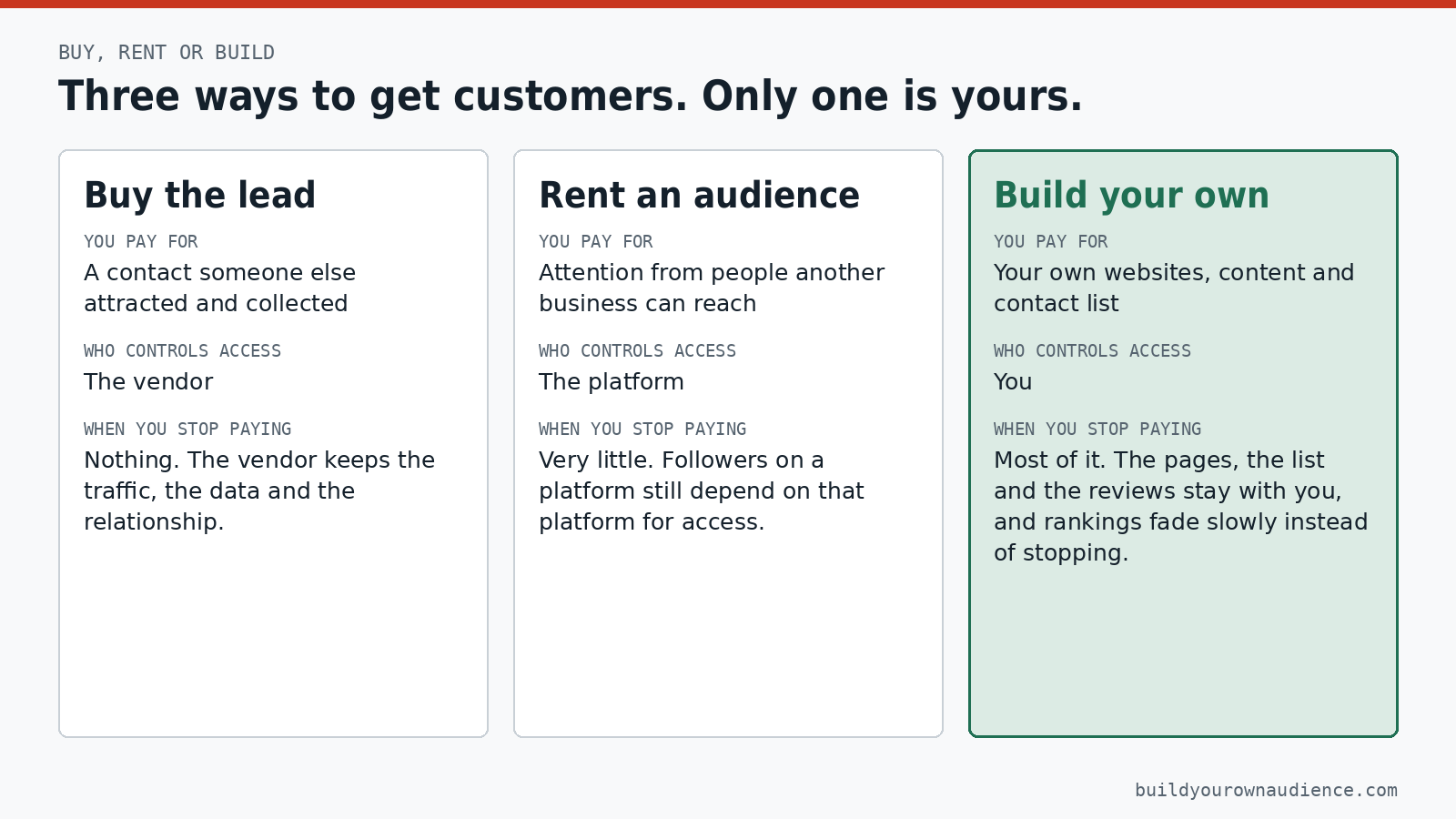
Build Your Own Audience's buy, rent or build framework sorts every way of getting customers into three: buying leads, renting attention and building an audience. Generating your own covers the last two.
| Approach | What you pay for | Who controls access | What's left when you stop paying |
|---|---|---|---|
| Buy the lead | A contact someone else attracted and collected | The vendor | Nothing. The vendor keeps the traffic, the data and the relationship. |
| Rent an audience | Attention from people another business can reach: social ads, sponsored newsletters, publisher placements | The platform | Very little. Followers on a platform still depend on that platform for access. |
| Build your own | Your own websites, content and contact list | You | Most of it. The pages, the list and the reviews stay with you, and rankings fade slowly instead of stopping. |
The cleanest way to tell them apart is to ask two questions. Where does the relationship start? And what remains the day after you stop paying?
Why does buying leads feel safe but cost more over time?
Buying leads is predictable, and that's its appeal. You pay a price per lead, leads arrive, your team calls them. For a business that needs volume this month, it works.
The cost shows up over time. A shared lead is usually sold to several buyers at once, so the moment the phone rings you're already in a race.
The vendor's margin is built into every lead, and that margin exists because the vendor owns something you don't: the audience. We break down where lead vendors get their leads in a separate guide.
You can spend for years and own none of it. When you stop, the pipeline goes to zero the same week.
Why is renting an audience only a halfway step?
Paid ads put your own message in front of people, which is a real step up from buying someone else's form fill. You control the offer, the landing page and the follow-up.
But the platform controls who sees you and what it costs. Prices move with competition, and an algorithm change can cut your reach overnight. In regulated categories the rules narrow further: Meta's special ad category rules for financial products and services and for housing remove ZIP code targeting and lookalike audiences, at the time of writing.
Rented attention works best when it lands on pages you own. Our guide to sending paid ads to your own site shows how to keep what the click creates.
What does "building your own audience" actually mean?
An audience is a group of people who find you directly and have given you permission to stay in touch. A website alone isn't one. A website plus a reason to come back, plus a way to reach people again, is.
The full definition, and what doesn't count, is in what an owned audience is.
- Findable pages
- Websites that show up in search results and in the answers AI assistants give.
- Useful content
- Guides, calculators and plain answers to the questions your customers already ask.
- A permission list
- Past customers, subscribers and people who asked to hear from you. See building an email list for lead generation.
- Reputation
- Reviews and referrals that bring people to you by name. See a system for reviews and referrals.
Owning the website is one piece. Earning the ongoing relationship is what turns visitors into an audience, and a site that doesn't convert visitors leaves that value on the table. Our guide on turning website visitors into leads covers that step.
How do the three work together?
Buying, renting and building work best together, not as all or nothing. The strongest setup uses rented attention to feed an owned audience:
- An ad or a search result
- Your own site
- They ask for information
- Useful follow-up
- A relationship you own
The ad is rented. Everything after the click is yours. Compare that with buying a lead, where everything before and after the inquiry belongs to someone else.
One year of buying leads
- A steady flow of inquiries while you pay
- Shared leads mean competing on the first call
- No rankings, list or content left at year end
- Next year costs the same, or more
One year of building
- A slow start while pages earn trust
- Inquiries from people who chose you
- Pages, a list and reviews that keep working
- Next year starts from what you already built
What does the shift cost in the short term?
Building is cheaper over years and more expensive over months. New pages take time to be found, and the first quarter often produces little. That dip is the real price of switching, and it's why cutting vendors all at once is a mistake.
The way through is to compare channels on cost per customer over a long window, not cost per lead this month. We work through an example in organic vs paid lead costs.
Why do the biggest companies buy audiences?
The largest players already think this way. When Rocket Companies bought the real estate site Redfin and then the mortgage servicer Mr. Cooper in 2025, it was buying audiences: nearly 10 million clients, plus the home shoppers who visit Redfin.
Those are relationships that produce refinances, home equity loans and purchase loans without paying a vendor each time. You don't need billions to apply the same logic. You need sites that earn their own traffic and a list of people who want to hear from you.
What to do next
Start by writing down what you spend on each of the three today, and what you'd own if every invoice stopped tomorrow. Then pick the first thing to build. Our guide to alternatives to buying leads puts them in order.
To see what moving part of your budget could look like with your own numbers, try the lead spend calculator.
Common questions
What's the difference between buying leads and building an audience?
Buying a lead means paying for a contact that someone else attracted. Building an audience means people find you directly, through your own website and content, and give you permission to stay in touch. Bought leads stop when payments stop. An audience keeps coming back.
Is renting an audience the same as buying leads?
No. Renting an audience means paying for attention, like ads on Facebook or a sponsored newsletter. You still have to turn that attention into an inquiry yourself. Buying a lead means someone else already did that and sells you the result.
Can you combine buying, renting and building?
Yes, and most businesses run all three for a while. The useful question is which way the budget is moving. Each quarter, more of it should go into assets you keep and less into contacts you rent.
Is buying leads legal?
Yes, buying leads is generally legal; the law controls how you contact them. In the US, autodialed or prerecorded marketing calls and texts usually need prior express written consent covering your company, and even hand-dialed sales calls to numbers on the Do Not Call registry need written permission or a recent inquiry. State laws can be stricter.